 Grace
GraceJoin the Selah Choir!
Sundays from 10/18 to 12/13 | Sanctuary | 11:30am-12:30pm Join the Selah Choir! Each year Selah Vocal Ministry leads us in worship during our special advent concert, A Dawning Light. Let us know you’re …
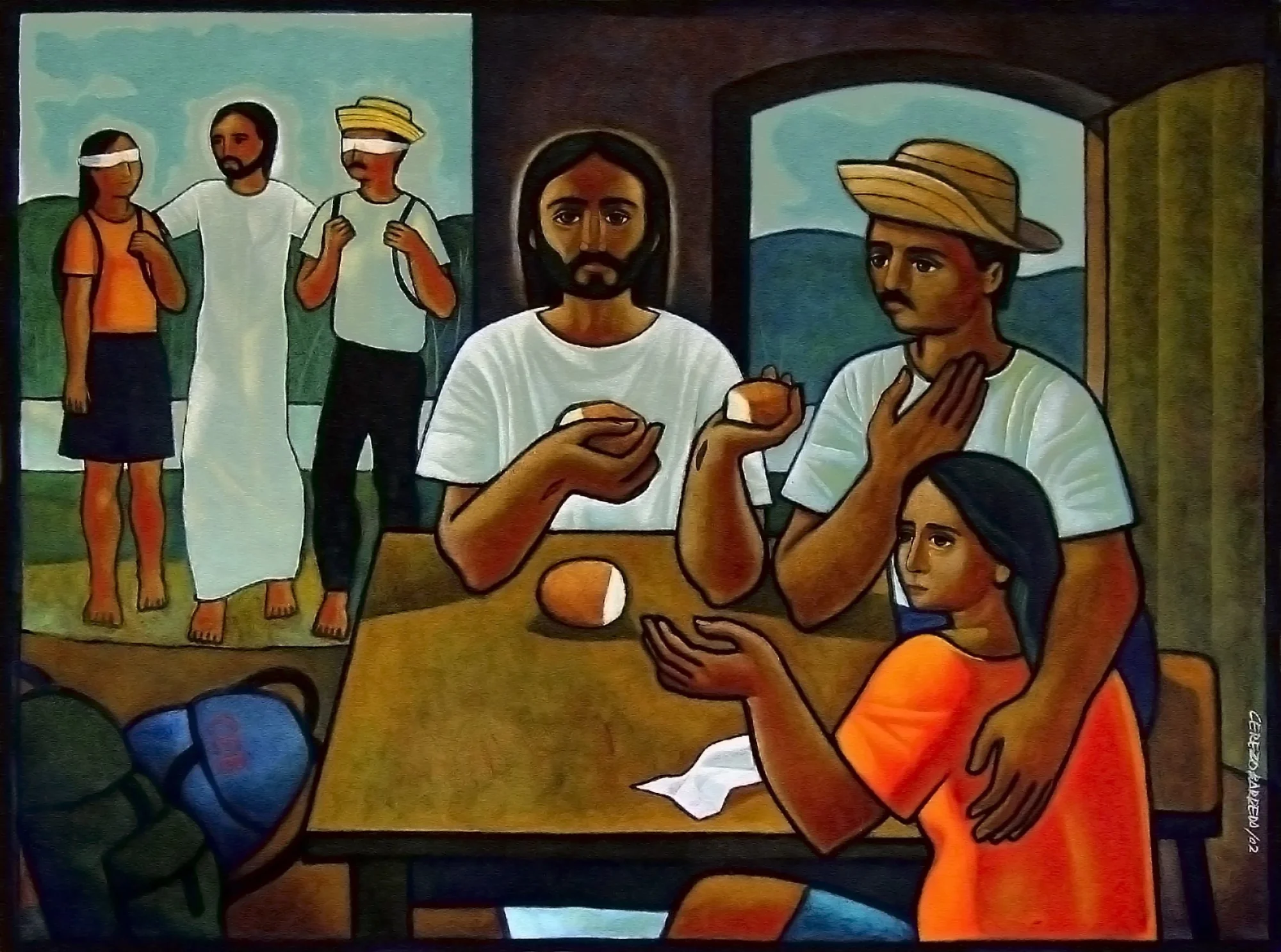
Artwork: Emmaus, by Maximino Cerezo Barredo, 2002.
Painted mural, 74 13/16 × 78 3/4 in. (190 × 200 cm). Centro de Formación de Animadores, Gatun Lake, Panama
Since its early days the church has made images, gathering the raw materials of God’s creation and combining and fashioning them into new forms. Frescoes, mosaics, illuminated manuscripts, wooden relief carvings, marble sculptures—these are just some of the many media historically used to call people into the grand narrative of scripture, helping them to experience it sensorily.
The purpose of religious images in the Middle Ages was threefold: to imprint the memory, to shape understanding, and to enkindle the affections and the will. Paintings as “books for the illiterate” is the oft-quoted line from Pope Gregory I, but didacticism wasn’t the only or even the primary function of art, as if those who could read had no need of it. In the same letter, Gregory says images train us in what to love and what to imitate. As we’re visually reminded of the ways God has acted in history, especially in the person of Christ but also through the saints, we are often moved to a deeper love of God and neighbor.
I’m focusing here on biblical art, by which I mean art that depicts people or events described in the Bible. I’m not saying artists who are Christian must create work of this kind, or that Christians should enjoy only biblical art. Christ is Lord over all of life, and art with any subject matter, of any style, has the potential to reveal beauty, goodness, and truth, regardless of the faith commitments of its maker. But I want to challenge the view that all biblical art is irrelevant, boring, kitschy, or merely illustrative. Besides the many fascinating historical art objects that are part of our heritage as Christians (whose riches we should be mining just as much as we do the theological literature and hymnody bequeathed to us by our predecessors in the faith), there are quite a few artists today, inside and outside the church, making art that responds to the Bible in fresh ways.
In my own devotional life, I’ve found that the visual arts can be potent stimuli to prayer. Contemplative engagement with images is sometimes referred to as visio divina, or sacred seeing, adapted from the practice of lectio divina, sacred reading. As you gaze attentively on an image, you open yourself up to receive the gift it holds, usually by dwelling with a particular detail that resonates most. Visio divina is not about trying to interpret art or place it in context but about opening the eyes of the heart. More being present to, less dissecting. Some call it praying with the eyes, a form of silent, receptive prayer.
My practice marries this kind of prayerful approach with a more analytical one, informed by the disciplines of art history and theology. (That sounds more academic than intended; I don’t have degrees in either.) Personal encounter with God is something I’m ready for, but I’m also interested in how artists play upon what came before and how art serves as a form of theology or biblical exegesis. Some Christians find it helpful, when looking at art, to separate spiritual and aesthetic modes of contemplation; I prefer integration. Whatever works best for you is perfectly fine. The important thing is slow looking and an openness to discovery.
Let’s practice prayerful looking with the Emmaus painting by Maximino Cerezo Barredo above. (For help interpreting it, you can consult its source text, Luke 24:13–35.)
Victoria Emily Jones blogs at ArtandTheology.org, exploring ways in which the arts can stimulate renewed engagement with the Bible. She serves as curator of the Daily Prayer Project and board member of the Eliot Society and has contributed to ArtWay, the Visual Commentary on Scripture, and the Encyclopedia of the Bible and Its Reception. Follow her on Instagram @art_and_theology.
Grace DC is one church made up of a network of local congregations throughout Washington, DC.
Office
637 Indiana Ave NW #300
Washington, DC 20004
Mailing Address
PO Box 14164
Washington, DC 20044